Bluetooth Codecs Explained for Commuter Earbuds — Head-to-Head Comparison of SBC, AAC, aptX, and LDAC
Published: February 1, 2026
Introduction — Why Codec Choice Matters for Commuter Earbuds
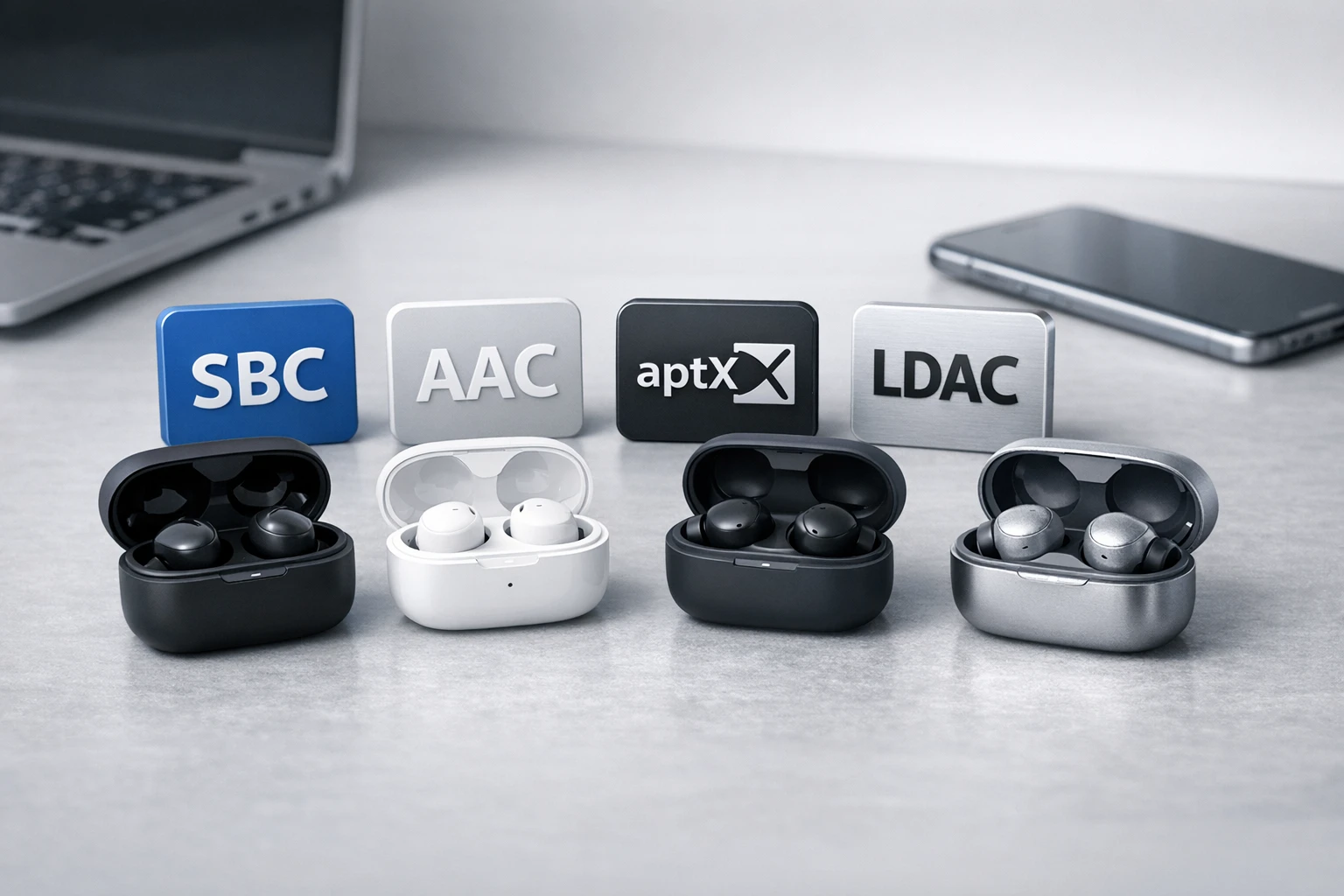
Bluetooth codecs explained for commuter earbuds is a practical topic for daily listeners who rely on wireless audio during transit. Commuters face a complex mix of requirements including battery life, speech clarity for calls, stable connectivity in crowded environments, and acceptable music quality. This article compares four common codecs — SBC, AAC, aptX, and LDAC — to help one select the best earbuds and settings for commuting scenarios.
The following comparison addresses compatibility, audio fidelity, latency, power consumption, and real-world performance. The reader will find specific examples, case studies, and step-by-step instructions for checking and changing codecs on common devices.
H2: Codec Fundamentals — How Bluetooth Codecs Work
One must understand that a codec is software that compresses and decompresses audio for transmission. Bluetooth audio is typically lossy, which means the codec reduces data size by discarding some information to fit bandwidth limits.
Key variables include bitrate (kilobits per second), sample rate (kilohertz), channel count, and latency (milliseconds). These variables determine perceived audio quality, responsiveness for video or games, and battery impact during commuting.
H3: Terms and Practical Implications
Bitrate indicates the amount of data transmitted per second and correlates with potential detail preservation. Higher bitrate typically allows for better fidelity but uses more radio bandwidth and device power.
Latency is the round-trip delay introduced by processing and transmission. Low latency is important for video synchronization and interactive voice applications during commutes when watching short clips or using navigation prompts.
H2: Codec Profiles — SBC, AAC, aptX, and LDAC Overview
H3: SBC (Sub-band Codec)
SBC is the mandatory baseline codec for all Bluetooth A2DP devices and therefore universal. It provides interoperability across all earbuds and devices but is not optimized for high fidelity or low latency in challenging environments.
Typical implementations vary between 192 kbps and 328 kbps effective bitrate with latency often in the 150 ms to 300 ms range. SBC is reliable for voice calls and podcast listening while commuting, though music enthusiasts will notice compression artifacts at low bitrates.
H3: AAC (Advanced Audio Coding)
AAC is widely used in Apple devices and many streaming services prefer AAC for encoded tracks. When paired with iPhones and iPads, AAC often achieves better real-world performance than SBC due to optimized stacks on those platforms.
On many Android devices, AAC performance can be inconsistent because of hardware and driver variability. For commuters who primarily use Apple devices, AAC offers a practical balance of quality and compatibility for podcast and music listening on crowded trains.
H3: aptX
aptX is an industry codec family originally developed by Qualcomm, designed to improve perceived audio quality and reduce latency versus SBC. The basic aptX variant typically operates around 352 kbps with latency near 70 ms in optimal conditions.
There are multiple aptX variants including aptX HD and aptX Adaptive. These enhance quality or robustness in varying conditions, and aptX Adaptive dynamically adjusts bitrate to maintain stable connections during movement on commutes.
H3: LDAC
LDAC is Sony's high-resolution codec capable of transmitting up to 990 kbps. It offers superior potential fidelity for compatible devices and high-resolution audio files when signal quality permits.
In crowded transit environments, airborne interference and packet loss may force LDAC to downgrade to lower bitrates, which reduces the theoretical advantage. LDAC also consumes more power, which affects battery life in earbuds and phones during long commutes.
H2: Head-to-Head Comparison
H3: Compatibility and Device Ecosystem
SBC is universally compatible and remains the fallback option. AAC is the dominant codec for Apple ecosystems and many streaming services, while aptX and LDAC require device and earbud support to function.
For commuters who switch between devices, one should prioritize broad compatibility. For example, a commuter carrying an iPhone and a Windows laptop may favor AAC-compatible earbuds, even if aptX or LDAC would yield better results on a single dedicated device.
H3: Audio Quality in Real-World Commuting
LDAC has the highest theoretical quality followed by aptX, AAC, and SBC. However, when commuting in subways or buses, physical interference frequently reduces throughput and forces codecs to operate at lower bitrates.
Practically, aptX Adaptive and LDAC in adaptive mode perform better than their fixed-rate counterparts because they maintain consistent playback while moving through coverage dead zones. This capability benefits commuters who traverse areas of variable signal congestion.
H3: Latency Considerations
SBC latency is acceptable for audio-only playback but can be distracting for videos and interactive applications. aptX variants and some implementations of AAC offer lower latency, which supports better lip-sync while watching short clips during a commute.
LDAC has historically higher latency, which makes it less suited for video synchronization unless the device and earbud firmware manage delay effectively. Commuters who frequently watch videos on the way to work should prioritize codecs with proven low latency.
H3: Battery Life and Power Consumption
Higher bitrates require increased processing and radio activity, which drains earbud and phone batteries more quickly. SBC and AAC tend to be more power-efficient than LDAC running at 990 kbps.
Commuters with longer transit times or limited opportunities to recharge may prefer codecs that conserve battery life, even if that choice reduces top-tier audio fidelity.
H2: Use Cases and Real-World Examples
H3: Case Study 1 — Daily Subway Commuter with an iPhone
A commuter uses an iPhone 14 and Apple AirPods Pro during a 45-minute subway ride. The iPhone and AirPods default to AAC and deliver consistent audio quality with reliable call performance.
AAC performs well here because Apple tightly integrates the codec stack. The commuter notices clear podcast speech and acceptable music detail while benefiting from excellent ANC and battery life from the earbuds.
H3: Case Study 2 — Urban Cyclist with Android Phone
An urban cyclist uses a high-end Android phone with aptX and a pair of true wireless earbuds that support aptX Adaptive. The connection maintains higher bitrate in open-air stretches and lowers bitrate if the cyclist passes through crowded areas, preserving continuity.
The adaptive behavior reduces stutters while providing improved quality for streamed playlists. The cyclist also benefits from reduced latency for navigation voice prompts and short video clip playback during stops.
H3: Case Study 3 — Audiophile Commuter with LDAC-Capable Gear
An audiophile carries a Sony smartphone and LDAC-capable earbuds on a commuter rail route. High-resolution tracks streamed from a smart player achieve rich detail at the beginning of the ride when the signal is clear.
During tunnels and station approaches, LDAC drops to lower bitrates and occasionally reverts to SBC-like performance. The commuter accepts occasional quality shifts in exchange for the best possible fidelity in open segments.
H2: Step-by-Step — How to Check and Change Codecs
H3: On Android
- Open Settings and navigate to System > About phone, then tap the Build number repeatedly to enable Developer options if not already enabled.
- Return to Settings, open Developer options, and find the Bluetooth audio codec menu.
- Select the preferred codec from the list (SBC, AAC, aptX, LDAC) and test with paired earbuds placed in the ear and in the commuter environment.
One must note that not all Android phones expose codec selection visually; behavior depends on Android version and vendor modifications. The earbud must support the selected codec for the change to take effect.
H3: On iOS
iOS does not allow manual codec selection for Bluetooth audio. The system manages codec choice automatically and prioritizes AAC for compatible accessories. A commuter using iOS should select earbuds known to perform well with the Apple ecosystem if consistent AAC performance is important.
H2: Pros, Cons, and Practical Recommendations
H3: SBC — Pros and Cons
- Pros: Universal compatibility, reasonable power efficiency, stable under interference.
- Cons: Limited fidelity, higher latency, artifacts at low bitrates.
H3: AAC — Pros and Cons
- Pros: Optimized for Apple devices, good balance of quality and power use in compatible ecosystems.
- Cons: Inconsistent performance on some Android phones, variable latency depending on implementation.
H3: aptX — Pros and Cons
- Pros: Better fidelity and lower latency than SBC in many implementations, adaptive variants increase robustness during movement.
- Cons: Requires device and earbud support, codec family fragmentation causes confusion for buyers.
H3: LDAC — Pros and Cons
- Pros: Highest theoretical fidelity, excellent for high-resolution audio in open-signal conditions.
- Cons: Higher power consumption, variable real-world stability in crowded transit, often higher latency.
H3: Practical Recommendations for Commuters
Commuters who value consistent call clarity, stable connections, and battery life should favor earbuds and settings that use AAC or SBC depending on device ecosystem. Those who prioritize music fidelity and have LDAC-capable hardware should accept occasional bitrate drops and increased battery use.
Users who switch between devices frequently should prioritize compatibility and choose earbuds with excellent ANC and microphone performance, since codec differences will have less audible impact when ambient noise levels are high.
H2: Final Checklist Before Purchase
- Confirm the phone and earbud codec support list and check whether aptX or LDAC is supported if high fidelity is desired.
- Test earbuds in real commuting conditions to evaluate connection stability and voice call quality.
- Consider the expected commute duration and battery life trade-offs when selecting higher-bitrate codecs.
- Verify firmware update paths: manufacturers often improve codec performance through firmware updates for earbuds and apps.
Conclusion — Making the Right Codec Choice for Commuter Earbuds
Bluetooth codecs explained for commuter earbuds reveals that there is no absolute best codec for all commuters. SBC provides universal stability, AAC works best within Apple environments, aptX offers a practical middle ground for many Android users, and LDAC provides top-shelf fidelity when conditions permit.
One should prioritize compatibility, real-world testing, battery considerations, and call quality rather than chasing maximum theoretical bitrates. By following the step-by-step checks and considering the recommended trade-offs, the commuter can select earbuds and settings that deliver the most satisfying daily listening experience.