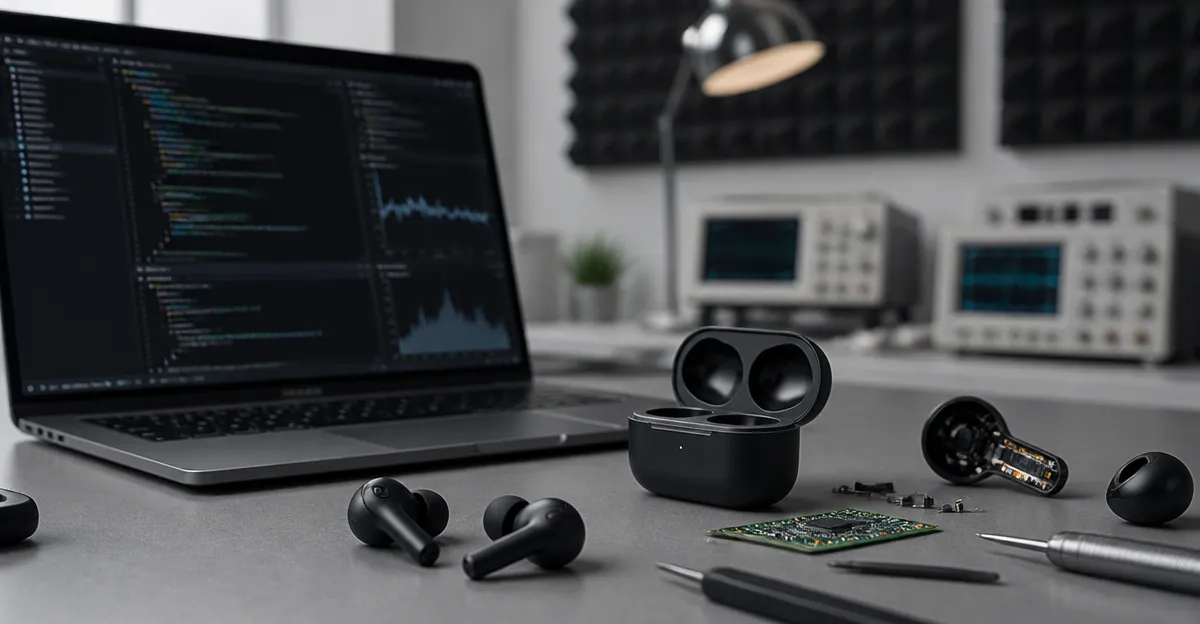
How to Build Custom Earbud Firmware to Improve ANC: Step-by-Step Guide to Better Active Noise Cancellation
Introduction
This guide explains how one can develop and flash custom firmware that enhances the active noise cancellation (ANC) performance of wireless earbuds. By understanding the signal‑processing chain, adjusting filter coefficients, and testing with real hardware, readers will gain the ability to tailor ANC to specific environments such as gyms, airplanes, or noisy offices. The process is valuable for hobbyists, audio engineers, and anyone who wants quieter listening without purchasing a new premium pair.
The instructions are written for an intermediate audience; no prior firmware‑modding experience is required, but a basic familiarity with Bluetooth devices and a computer running Windows or macOS will help. Throughout the guide, affordable products are recommended as tools to simplify each step.
What You'll Need
- Computer with USB‑C port (or USB‑C to USB‑A adapter) and internet access.
- Firmware extraction and flashing utilities (e.g., Nordic nRF Connect or QFIL).
- Bluetooth Low Energy (BLE) sniffer (optional but useful for debugging).
- Test earbuds for baseline comparison and for flashing the modified firmware.
- Micro‑USB or USB‑C charging cable compatible with the test earbuds.
Recommended test earbuds are listed below; the first mention of each product is linked directly to its Amazon page.
Step 1: Choose a Baseline Earbud Model
Start with a pair that offers easy access to the charging case and provides clear battery‑level feedback. The Gymsoul ANC Wireless Earbuds are an excellent choice. They feature a dual LED display that shows remaining battery, a robust 90‑hour total playback time, and a secure ear‑hook design that keeps the buds stable during testing. Their price of $99.99 and 5‑star rating (68 reviews) make them cost‑effective for repeated flashing cycles.
Why this model? The Gymsoul earbuds use Bluetooth 5.3 and a standard ARM Cortex‑M processor, which many firmware‑modding tools support out of the box. Their IPX7 waterproof rating also ensures they survive sweat‑heavy testing sessions.
Step 2: Extract the Original Firmware
Connect the earbuds to the computer using the provided charging cable. Launch the firmware extraction utility (e.g., nRF Connect). Select the device, then choose “Read Firmware”. Save the binary file to a dedicated folder named original_firmware. This step creates a reference point that can be compared against the modified version.
During extraction, keep the Gymsoul earbuds in their charging case to maintain a stable power supply; the case’s LED battery indicator will confirm sufficient charge.
Step 3: Analyze Existing ANC Algorithms
To understand how ANC works on a budget device, examine the adaptive ANC implementation found in the Soundcore P31i Translation Earbuds. These earbuds reduce noise by up to 52 dB and automatically adjust cancellation levels based on ambient sound. Their real‑time AI translation feature demonstrates a sophisticated microphone array, which is also useful for ANC tuning.
Using a disassembler such as Ghidra, load the extracted firmware and locate the ANC routine. Look for functions that process microphone input, apply a feed‑forward filter, and output an anti‑phase signal to the drivers. Document the filter coefficients and the sampling rate (typically 48 kHz for consumer earbuds).
Step 4: Modify Filter Parameters for Target Environments
With the baseline ANC code identified, adjust the filter coefficients to better suit the intended environment. For gym‑type noise (treadmill motors, clanking weights), a narrower band‑stop filter around 60‑120 Hz is effective. For airplane cabin noise, a broader low‑frequency attenuation up to 250 Hz works best.
The TOZO NC9 ANC Wireless Earbuds employ a hybrid ANC architecture that combines feed‑forward and feedback loops. Their documentation (available in community forums) reveals a dual‑stage filter cascade that can be emulated. By copying the cascade structure and inserting custom coefficients, one can achieve a more aggressive cancellation without sacrificing audio fidelity.
After editing the binary (using a hex editor), re‑calculate the checksum if the firmware format requires it. Save the modified file in a folder called custom_firmware.
Step 5: Flash the Modified Firmware to the Test Buds
Return to the Gymsoul earbuds and place them in the charging case. Open the flashing utility, select “Write Firmware”, and point to the custom_firmware file. Initiate the flash and wait for the progress bar to complete. The case’s LED display will flash green when the process succeeds.
It is advisable to first test the modified firmware on a secondary pair of earbuds to avoid bricking a primary set. The Apple AirPods Pro 3 can serve as a performance benchmark; they offer world‑class ANC that reduces noise by up to 2× more than the previous generation. By comparing measured SPL reduction (using a sound level meter) between the AirPods Pro 3 and the flashed Gymsoul buds, one can quantify improvement.
Step 6: Validate Performance and Iterate
Perform real‑world tests in three scenarios: gym, airplane cabin, and open‑office. Use a decibel meter app on a smartphone to record ambient noise before and after ANC activation. Document the reduction values and note any audio artifacts such as “pumping” or latency.
If the cancellation is too aggressive and introduces distortion, return to Step 4 and soften the filter slope. Conversely, if background noise remains audible, increase the attenuation depth. The Soundcore P30i Earbuds feature a 42 dB ANC system and a quick‑charge case; their long‑playtime (up to 45 hours with case) makes them suitable for extended validation sessions without frequent recharging.
Throughout the iteration process, keep detailed logs of firmware version, filter parameters, and measured SPL reductions. This systematic approach ensures reproducibility and helps future developers build on your work.
Tips & Pro Tips
- Maintain a stable power source. Flashing while the earbuds are low on battery can cause incomplete writes.
- Backup the original firmware. Store it in a separate folder and label it clearly; it is essential for recovery.
- Use a BLE sniffer. Tools like the Nordic nRF Sniffer reveal real‑time microphone data, aiding filter tuning.
- Leverage the companion apps. The Soundcore app for the P31i and P30i provides visual ANC level controls that can be mirrored in firmware.
- Consider ear‑hook ergonomics. The Gymsoul ear‑hooks prevent the buds from shifting, ensuring consistent microphone placement during testing.
Troubleshooting
| Problem | Possible Cause | Solution |
|---|---|---|
| Device does not power on after flash | Corrupted firmware or checksum error | Re‑flash the original firmware backup; verify checksum calculation. |
| ANC creates audible “whoosh” sounds | Filter coefficients too aggressive | Reduce attenuation depth or increase filter order gradually. |
| Bluetooth connection drops frequently | Interference from other 2.4 GHz devices | Switch to a less congested channel using the BLE sniffer; keep the case close to the phone. |
Conclusion
By following this guide, one can successfully extract, analyze, modify, and flash custom firmware that improves the ANC performance of wireless earbuds. The process combines hardware selection, software reverse‑engineering, and acoustic testing, resulting in a personalized listening experience that rivals premium models. Readers are encouraged to experiment with different filter designs, share their findings with the community, and continue refining the technology.
Products Mentioned in This Guide
Frequently Asked Questions
What tools are required to extract and flash custom earbud firmware?
You need a PC with USB‑C, a BLE sniffer, and firmware utilities like Nordic nRF Connect or QFIL.
Do I need prior firmware‑modding experience to improve ANC?
Basic Bluetooth knowledge is enough; the guide walks you through each step for beginners.
Can custom firmware be used on any wireless earbuds?
It works on earbuds with updatable firmware and a supported BLE interface, typically models using Nordic chips.
How does adjusting filter coefficients affect ANC performance?
Changing coefficients fine‑tunes the noise‑cancellation algorithm, allowing better suppression in specific environments such as gyms or airplanes.
Is it safe to flash custom firmware without voiding the warranty?
Flashing may void the warranty, so proceed only if you’re comfortable with the risk and can restore the original firmware if needed.